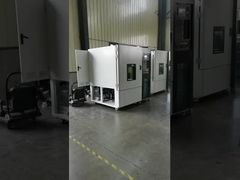
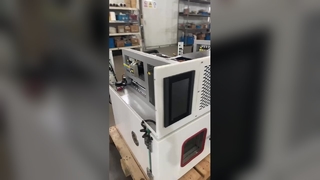
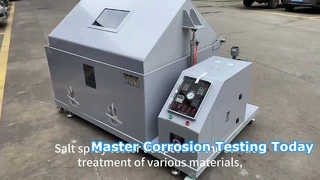
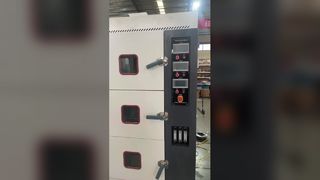
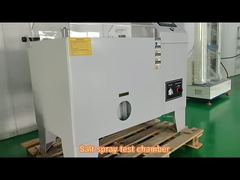
Salt Spray Test Chamber Corrosion Resistance

Other Videos
December 24, 2025
Category Connection: Salt Spray Test Chamber
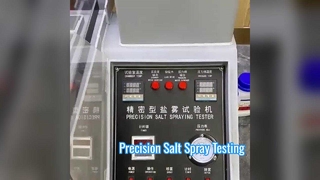
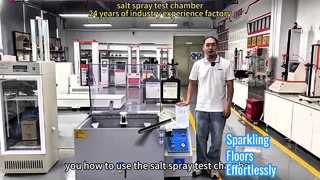
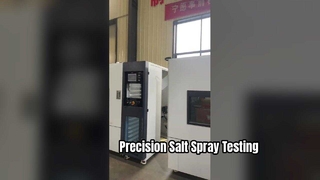
Brief: In this video, we provide a detailed walkthrough of the Cyclic Corrosion Test Chamber, demonstrating how it simulates harsh environmental conditions to evaluate material corrosion resistance. Follow the narrative to see how small design choices affect everyday performance, from precise spray control to adherence to ASTM B117 standards, ensuring reliable test results for industrial applications.
Related Product Features:
  • Simulates corrosive environments to accurately assess material corrosion resistance under laboratory conditions.
  • Wide test temperature range from 35℃ to 55℃ with controlled humidity at 95% RH.
  • Complies with ASTM B117 standard for salt spray testing with durations from 48 to 1000 hours.
  • Features multiple safety protections including overload, overheating, and leakage protection.
  • Constructed from durable SUS304 chamber material for long-lasting performance.
  • Offers precise spray control with adjustable distance from 30cm to 50cm and nozzle sizes from 0.3mm to 0.8mm.
  • Available in various test areas from 0.09m² to 2.25m² to suit different sample sizes.
  • Equipped with a PLC/PC control system for easy operation and accurate test management.
FAQs:
  • What is the purpose of using a Salt Spray Test Chamber?
    The Salt Spray Test Chamber simulates corrosive environments to evaluate the corrosion resistance of industrial materials and coatings, such as stainless steel, aluminum alloy, and painted surfaces, under controlled laboratory conditions.
  • What standards does this test chamber comply with?
    This chamber is designed to test in accordance with the ASTM B117 standard, ensuring reliable and standardized corrosion resistance evaluations.
  • What safety features are included in the Salt Spray Test Chamber?
    The chamber includes multiple safety protections such as overload protection, overheating protection, and leakage protection to ensure operational safety and result reliability.
  • What are the available test durations and temperature ranges?
    Testing can range from 48 hours to 1000 hours, with a temperature range from 35℃ to 55℃, allowing for flexible and comprehensive corrosion assessment.